Ruby on Rails Upgrade Services: How Nextware Systems Modernizes Legacy Rails Applications Without Breaking Production
Is Your Ruby on Rails Application Falling Behind?
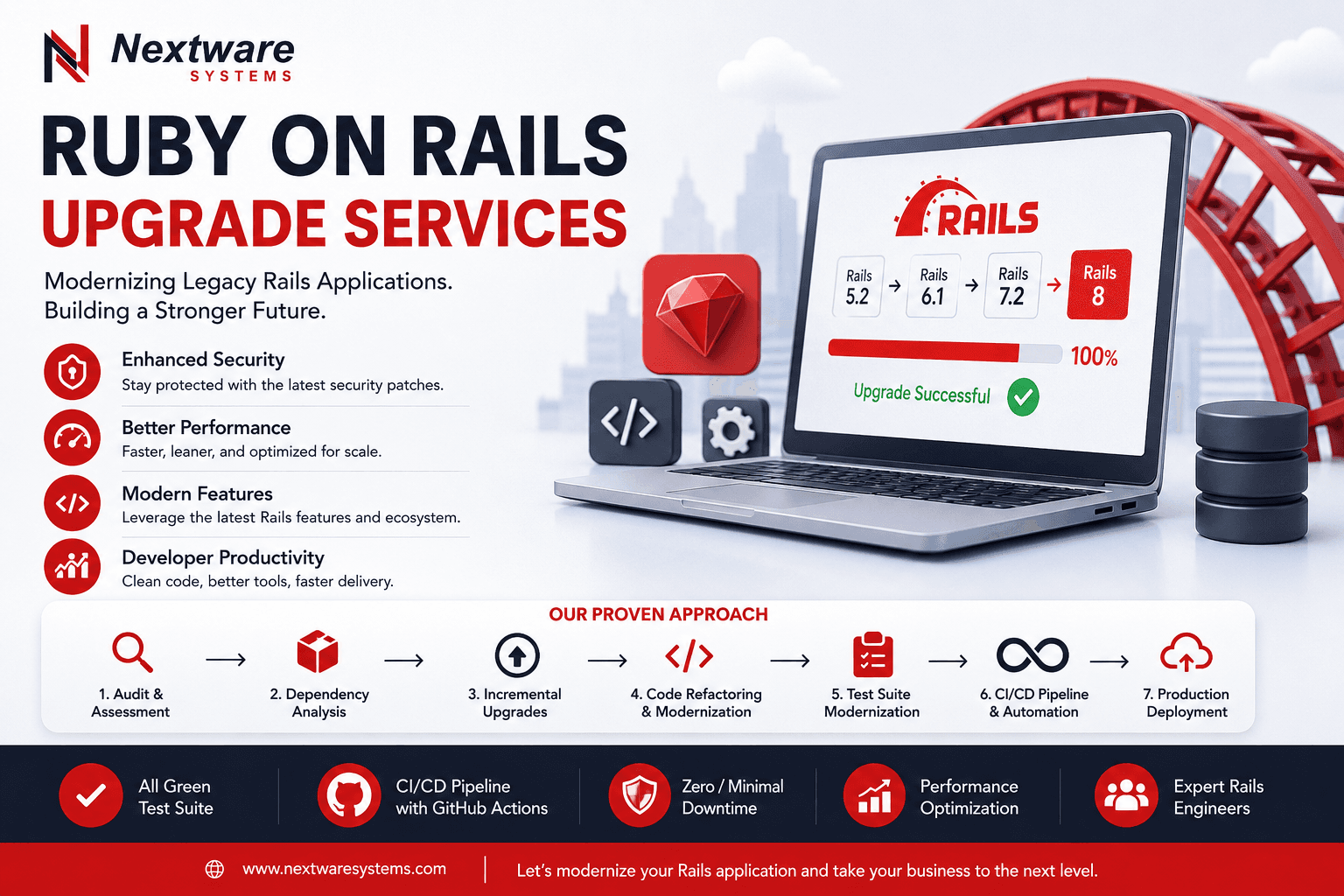
Many organizations continue to run business-critical applications on older versions of Ruby on Rails. While these applications may still function, outdated frameworks introduce security vulnerabilities, compatibility issues, performance bottlenecks, and rising maintenance costs.
At Nextware Systems, we've successfully upgraded Ruby on Rails applications across multiple versions while ensuring minimal downtime, full test coverage, and a reliable CI/CD pipeline.
Whether your application is running Rails 4, Rails 5, Rails 6, or Rails 7, our engineering team follows a structured modernization strategy that minimizes risk and accelerates delivery.
Why Upgrade Ruby on Rails?
Keeping your Rails application current provides significant business and technical advantages.
Security
Latest security patches
Protection against newly discovered vulnerabilities
Updated dependency ecosystem
Performance
Faster application boot times
Improved Active Record performance
Better memory utilization
Modern Ruby runtime optimizations
Long-Term Maintainability
Easier dependency updates
Better compatibility with modern gems
Reduced technical debt
Lower infrastructure costs
Developer Productivity
Modern Rails features
Better debugging tools
Faster development workflows
Cleaner architecture
Our Proven Rails Upgrade Process
Rather than attempting one large upgrade, we follow an incremental approach that significantly reduces project risk.
Step 1 — Comprehensive Application Audit
Before touching any code, we analyze:
Current Ruby version
Current Rails version
Gem compatibility
Database architecture
Background jobs
Authentication systems
APIs
Active Storage
Action Cable
JavaScript stack
Deployment pipeline
The result is a detailed upgrade roadmap with estimated effort and identified risks.
Step 2 — Dependency Analysis
Many upgrade failures originate from outdated gems.
Our team:
Removes abandoned gems
Replaces deprecated libraries
Updates supported dependencies
Resolves version conflicts
Modernizes configuration
This creates a stable foundation before upgrading Rails itself.
Step 3 — Incremental Ruby & Rails Upgrades
Instead of jumping several versions at once, we upgrade sequentially.
Example:
Rails 5.2
↓
Rails 6.0
↓
Rails 6.1
↓
Rails 7.0
↓
Rails 7.2
↓
Rails 8
Each upgrade is tested thoroughly before proceeding.
Step 4 — Refactoring Deprecated APIs
Rails introduces deprecations every release.
Our engineers resolve:
Deprecated Active Record methods
Controller changes
Routing updates
Zeitwerk autoloading migration
Asset pipeline modernization
Importmap / ESBuild / Vite migration
Turbo and Hotwire adoption where beneficial
Step 5 — Modernizing the Test Suite
A Rails upgrade is only successful when every critical workflow is validated automatically.
Our team updates and stabilizes:
RSpec
Minitest
FactoryBot
Capybara
System Tests
Request Specs
Integration Tests
API Tests
We eliminate flaky tests, improve coverage, and ensure the suite reflects current business behavior.
Step 6 — CI/CD Pipeline Modernization
Continuous Integration is a key part of every upgrade.
We configure automated pipelines that:
Install dependencies
Run RuboCop
Execute security scans
Run the complete test suite
Validate migrations
Build production assets
Generate deployment artifacts
Only fully passing builds are eligible for deployment.
Our objective is simple:
Every pull request must finish with a fully green pipeline.
Step 7 — Performance Validation
After upgrading, we benchmark:
Response times
Memory consumption
SQL queries
N+1 issues
Background jobs
Cache performance
Performance improvements are measured—not assumed.
Step 8 — Production Deployment
Deployment includes:
Zero or minimal downtime strategy
Database migration planning
Rollback procedures
Health monitoring
Error tracking
Post-release validation
This reduces operational risk during production rollout.
What We Upgrade
Our team modernizes:
Ruby versions
Ruby on Rails
PostgreSQL
Redis
Sidekiq
Devise
ActiveAdmin
Stimulus
Turbo
Hotwire
Webpacker
Importmap
JavaScript tooling
Docker
GitHub Actions
CI/CD infrastructure
Cloud deployment pipelines
Why Companies Choose Nextware Systems
Our engineers bring years of hands-on Ruby on Rails experience across SaaS platforms, enterprise systems, healthcare, fintech, logistics, and internal business applications.
Clients trust us because we deliver:
Structured upgrade plans
Reduced business risk
Production-safe deployments
Fully updated test suites
Green CI/CD pipelines
Performance optimization
Ongoing maintenance and support
We don't just upgrade versions—we modernize your engineering workflow so your application is easier to maintain and evolve.
Ready to Modernize Your Rails Application?
If your application is running an older version of Ruby on Rails, now is the right time to invest in modernization before technical debt becomes a business risk.
Whether you need a complete framework upgrade, dependency modernization, test suite stabilization, or CI/CD implementation, Nextware Systems can help.
Let's transform your legacy Rails application into a secure, high-performance platform built for the future.
Related posts
Hotwire in Practice: Turbo Frames vs Turbo Streams
When to reach for a Turbo Frame, when to broadcast a Turbo Stream, and how to keep a Hotwire app fast and debuggable.
Read more
Scaling a Rails Monolith Without Microservices
Rails monoliths scale further than the internet admits. Service objects, good indexes, and background jobs get you remarkably far.
Read more
Background Jobs in Rails 8 with Solid Queue
Solid Queue brings durable, database-backed jobs to Rails by default. Setup, recurring tasks, and when you still want Sidekiq.
Read moreTrending posts
Announcing Our Next Open-Source Initiative: Building AI Applications with the Claude API Using Ruby & Ruby on Rails
Introducing: Building AI Applications with the Claude API Using Ruby & Ruby on Rails
Read more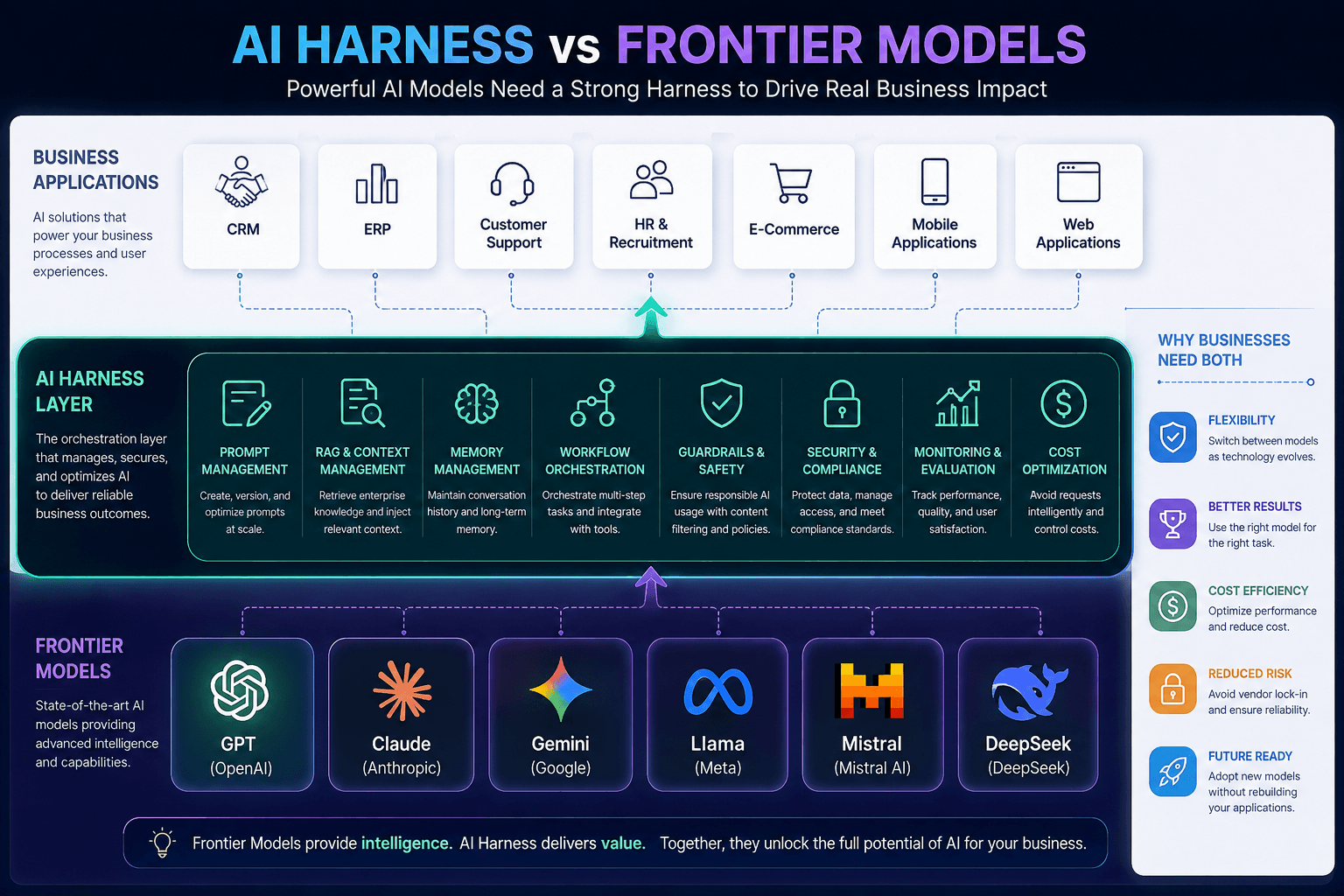
AI Harness vs Frontier Models: Why Enterprises Need More Than Just Powerful AI
Artificial Intelligence is evolving at an incredible pace. Every few months, a new "most powerful" AI model is announced, capable of writing code, generating content, solving complex problems, or even acting as an autonomous agent. While these frontier models receive most of the attention, successful AI implementations inside businesses rely on something equally important—an AI Harness. Understanding the distinction can help organizations avoid expensive AI mistakes and build scalable, secure, and future-ready AI solutions.
Read more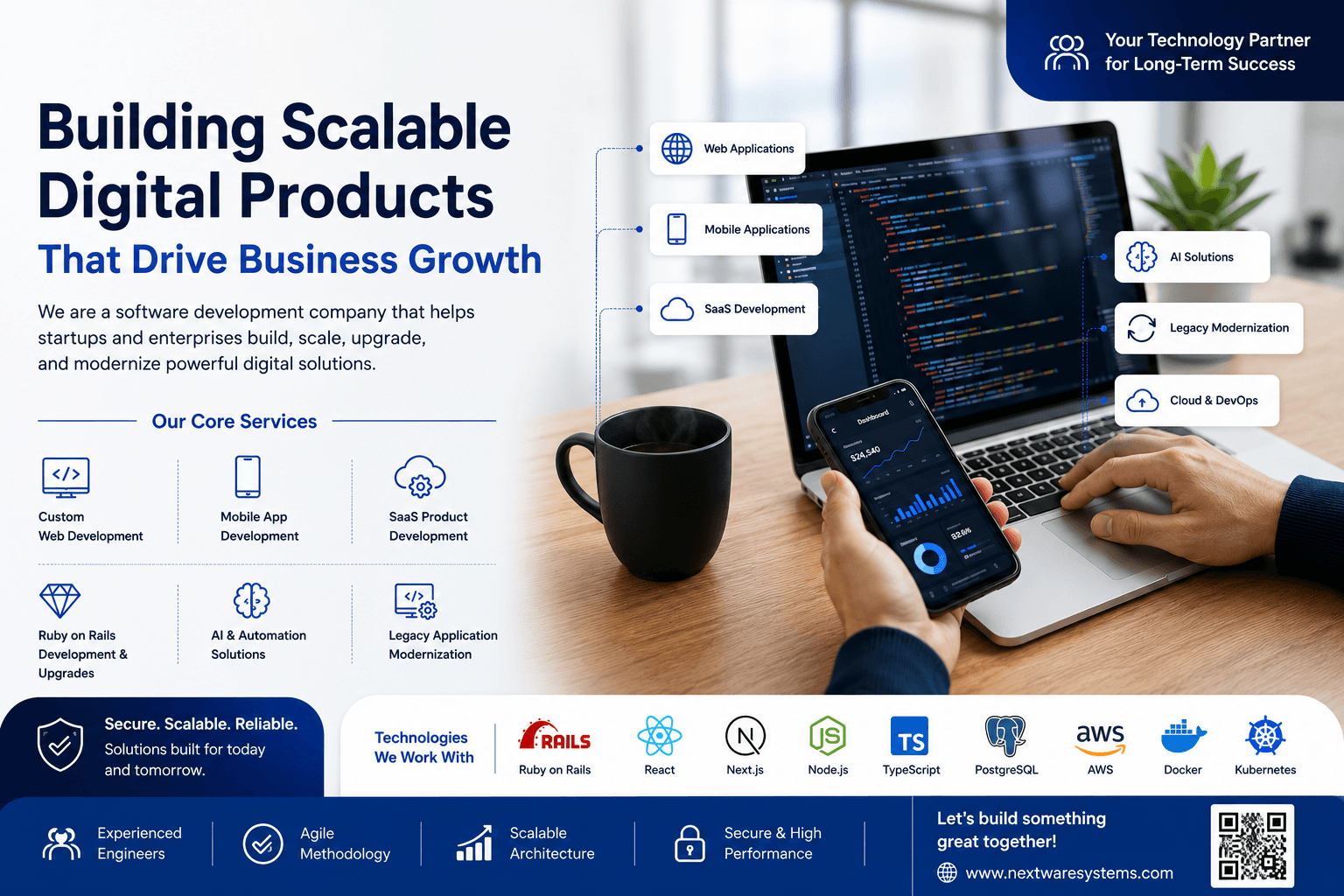
Building Digital Products That Scale: Why Businesses Choose Nextware Systems as Their Technology Partner
Building Digital Products That Scale: Why Businesses Choose Nextware Systems as Their Technology Partner
Read morePopular posts
Background Jobs in Rails 8 with Solid Queue
Solid Queue brings durable, database-backed jobs to Rails by default. Setup, recurring tasks, and when you still want Sidekiq.
Read more
Server Components in Next.js 15: A Practical Mental Model
RSC changes where code runs. A working mental model for fetching, the client boundary, and shipping less JavaScript.
Read more
Deploying with Docker and Kamal on a Plain VPS
Containerize once and deploy anywhere you can SSH. Kamal brings zero-downtime deploys and TLS to a cheap server.
Read more
Rails 8 Is Here: The No-PaaS Default Stack Explained
Rails 8 ships with Kamal 2, Solid Queue, Solid Cache and Propshaft, making a database-only, deploy-anywhere stack the default. Here is what changes.
Read more
0 Comments
Sign in to join the conversation.
Sign-in is not configured yet.