AI Harness vs Frontier Models: Why Enterprises Need More Than Just Powerful AI
Artificial Intelligence is evolving at an incredible pace. Every few months, a new "most powerful" AI model is announced, capable of writing code, generating content, solving complex problems, or even acting as an autonomous agent. While these frontier models receive most of the attention, successful AI implementations inside businesses rely on something equally important—an AI Harness. Understanding the distinction can help organizations avoid expensive AI mistakes and build scalable, secure, and future-ready AI solutions.
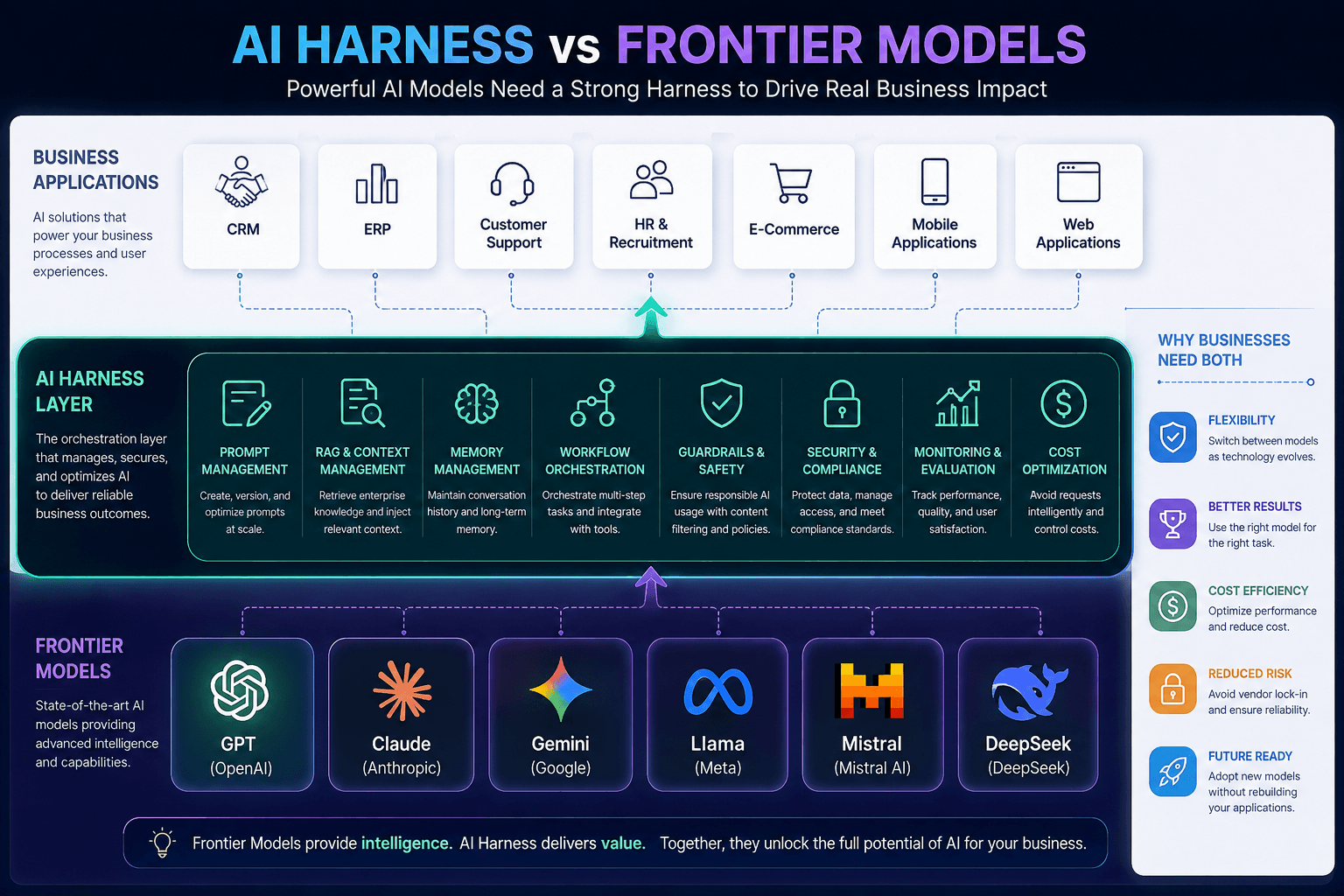
What Are Frontier Models?
Frontier models are the most advanced AI foundation models available today. These models are trained on enormous datasets using massive computational resources and provide state-of-the-art capabilities.
Some well-known frontier models include:
GPT-5.x
Claude
Gemini
Llama
DeepSeek
Mistral
These models excel at:
Natural language conversations
Code generation
Document analysis
Image understanding
Data summarization
Research assistance
Reasoning and planning
However, they are general-purpose intelligence engines—not complete business applications.
What is an AI Harness?
An AI Harness is the software platform that connects AI models with your business systems.
Instead of relying on a single model, it manages multiple AI providers while handling everything needed for production environments.
Typical responsibilities include:
Model selection
Prompt management
Context injection (RAG)
Memory management
Tool execution
API integrations
Workflow orchestration
Guardrails
Security
Cost optimization
Logging and monitoring
Human approvals
Performance evaluation
The harness transforms raw AI capability into reliable enterprise automation.
AI Harness vs Frontier Models
Frontier ModelsAI HarnessAI BrainAI Operating SystemGenerates intelligenceUses intelligence effectivelySingle modelSupports multiple modelsGeneral purposeBusiness specificNo business workflowsComplete workflow automationNo enterprise integrationsConnects ERP, CRM, HRMS, databasesNo governanceSecurity and complianceLimited monitoringFull observabilityVendor dependentVendor agnostic
Why Businesses Shouldn't Depend on One AI Model
The AI landscape changes rapidly.
Today's best model might not remain the leader next year.
Building directly around a single model creates vendor lock-in.
An AI Harness allows organizations to:
Switch between AI providers easily
Compare model performance
Reduce infrastructure costs
Improve reliability
Maintain business continuity
Adopt newer models without rewriting applications
Typical Enterprise AI Architecture
Business Applications
        │
        ▼
   AI Harness Layer
──────────────────────────
Prompt Management
RAG
Memory
Workflow Engine
Security
Evaluation
Monitoring
Cost Control
──────────────────────────
        │
        ▼
Multiple Frontier Models

GPT
Claude
Gemini
Llama
Mistral
DeepSeek
This architecture gives enterprises flexibility while protecting them from rapid technology changes.
Real-World Example
Imagine a customer support platform.
Without an AI Harness:
Every request goes to one AI model.
No quality checks.
No context.
No memory.
No approval process.
With an AI Harness:
Customer history is retrieved.
Company knowledge base is searched.
The best AI model is selected.
Sensitive information is filtered.
Responses are validated.
Human approval is requested when necessary.
All interactions are logged for compliance.
The result is a reliable enterprise-grade AI assistant.
Why AI Harnesses Matter More as AI Evolves
As organizations adopt multiple AI agents and increasingly complex workflows, managing AI becomes more challenging.
Modern enterprises need:
AI governance
Agent orchestration
Multi-model routing
Performance benchmarking
Security controls
Compliance auditing
Cost optimization
These capabilities belong in the AI Harness—not the underlying model.
How Nextware Systems Can Help
At Nextware Systems, we help businesses move beyond AI experimentation to production-ready AI solutions.
Our expertise includes:
Enterprise AI architecture
AI Harness development
Agentic AI workflows
Retrieval-Augmented Generation (RAG)
Multi-model orchestration
AI-powered web and mobile applications
Legacy application modernization with AI
AI integrations with existing enterprise systems
Whether you're building your first AI application or scaling AI across your organization, we design solutions that are secure, scalable, and future-proof.
Final Thoughts
Frontier models provide extraordinary intelligence, but intelligence alone isn't enough to solve business problems.
The real competitive advantage comes from combining powerful AI models with a robust AI Harness that orchestrates workflows, ensures governance, integrates business systems, and adapts to an evolving AI ecosystem.
Businesses that invest in both will be better positioned to innovate, reduce costs, and deliver exceptional customer experiences.
Need help building enterprise AI solutions?
Nextware Systems specializes in AI-powered web applications, mobile applications, AI agent development, automation, and enterprise software modernization. Contact us to discover how AI can accelerate your business.
Related posts
Announcing Our Next Open-Source Initiative: Building AI Applications with the Claude API Using Ruby & Ruby on Rails
Introducing: Building AI Applications with the Claude API Using Ruby & Ruby on Rails
Read more
Choosing a Vector Database for AI Search
pgvector, Pinecone, Qdrant, Weaviate — how to pick a vector store based on scale, filtering needs, and operational appetite.
Read more
Building Reliable AI Workflows with LangChain
LangChain helps compose LLM steps, tools, and memory. Where it helps, where it gets in the way, and how to keep chains debuggable.
Read moreTrending posts
Announcing Our Next Open-Source Initiative: Building AI Applications with the Claude API Using Ruby & Ruby on Rails
Introducing: Building AI Applications with the Claude API Using Ruby & Ruby on Rails
Read more
Building Digital Products That Scale: Why Businesses Choose Nextware Systems as Their Technology Partner
Building Digital Products That Scale: Why Businesses Choose Nextware Systems as Their Technology Partner
Read more
Ruby on Rails Upgrade Services: How Nextware Systems Modernizes Legacy Rails Applications Without Breaking Production
Is Your Ruby on Rails Application Falling Behind?
Read morePopular posts

Background Jobs in Rails 8 with Solid Queue
Solid Queue brings durable, database-backed jobs to Rails by default. Setup, recurring tasks, and when you still want Sidekiq.
Read more
Server Components in Next.js 15: A Practical Mental Model
RSC changes where code runs. A working mental model for fetching, the client boundary, and shipping less JavaScript.
Read more
Deploying with Docker and Kamal on a Plain VPS
Containerize once and deploy anywhere you can SSH. Kamal brings zero-downtime deploys and TLS to a cheap server.
Read more
Rails 8 Is Here: The No-PaaS Default Stack Explained
Rails 8 ships with Kamal 2, Solid Queue, Solid Cache and Propshaft, making a database-only, deploy-anywhere stack the default. Here is what changes.
Read more
0 Comments
Sign in to join the conversation.
Sign-in is not configured yet.