Announcing Our Next Open-Source Initiative: Building AI Applications with the Claude API Using Ruby & Ruby on Rails
Introducing: Building AI Applications with the Claude API Using Ruby & Ruby on Rails
Artificial Intelligence is transforming the way modern software is built. Every day, developers are integrating Large Language Models (LLMs) into web applications, mobile apps, internal tools, customer support systems, developer workflows, and enterprise software.
However, one challenge continues to stand out.
Most AI tutorials, courses, and examples are built using Python.
While Python is an excellent language for AI research and machine learning, Ruby developers are often left searching for production-ready examples that fit naturally into Ruby and Ruby on Rails applications.
At Nextware Systems, we believe the Ruby community deserves high-quality AI education built specifically for Ruby developers.
Today, we're excited to announce our newest open-source initiative.
Building AI Applications with the Claude API Using Ruby & Ruby on Rails
Over the coming months, we'll be creating a comprehensive, production-focused course designed entirely around Ruby and Ruby on Rails.
Rather than simply translating Python notebooks into Ruby, we'll build every lesson from the ground up using Ruby best practices, Rails architecture, service objects, testing, background jobs, and production-ready design patterns.
Our goal is simple:
Help Ruby developers build real AI applications—not just API demos.
What You'll Learn
This course will cover everything from beginner concepts to advanced production systems, including:
Claude API fundamentals
Prompt engineering
Multi-turn conversations
Response streaming
Structured outputs
Prompt evaluation
Tool calling
Retrieval-Augmented Generation (RAG)
Image understanding
PDF processing
Prompt caching
Model Context Protocol (MCP)
Claude Code
AI Agents and Workflows
Production AI architecture with Ruby on Rails
Building and deploying AI-powered SaaS applications
Every lesson will include practical implementations using modern Ruby development practices.
What Makes This Course Different?
We're designing this course to be much more than a collection of code snippets.
Every lesson will include:
📖 Detailed written explanations
💻 Pure Ruby examples
🚂 Ruby on Rails implementations
🧪 RSpec tests
🏗 Production-ready architecture
📊 Architecture diagrams
🎥 Video lesson scripts
🎞 Screencast plans
📝 Technical blog articles
🧩 Hands-on exercises
✅ Complete solutions
📚 GitHub source code
⚠️ Common mistakes and best practices
By the end of the course, you'll know how to build scalable AI applications that are ready for production.
Building in Public
One of our goals is to build this course openly.
As we develop each lesson, we'll share:
Progress updates
GitHub repositories
Technical blogs
Architecture discussions
Ruby examples
Rails implementations
Design decisions
Lessons learned
We hope this transparency will help other developers while also allowing us to continuously improve the course based on community feedback.
We Need Your Help
This is where we'd love your participation.
Whether you're an experienced Ruby developer, a Rails architect, an AI enthusiast, or someone just beginning your AI journey, your feedback can help shape this course.
We're especially interested in hearing:
Which Claude API topics are you most excited to learn?
What AI applications are you currently building?
Which Ruby AI libraries or integrations would you like to explore?
What challenges have you faced while adding AI to Ruby or Rails applications?
What production topics do you think are often missing from existing AI courses?
Are there real-world projects you'd like us to build as part of the course?
If you have ideas, feature requests, or examples you'd like to see, we'd love to hear them.
Join the Journey
Our vision is to create one of the most comprehensive AI learning resources available for the Ruby ecosystem.
We'll be sharing every milestone along the way through:
Nextware Systems Blog
GitHub
LinkedIn
Facebook
YouTube
Live coding sessions
Open-source repositories
If this sounds interesting, follow our journey, share this announcement with fellow Ruby developers, and leave your suggestions in the comments.
Together, let's build something that helps the entire Ruby community embrace AI with confidence.
The first lesson is coming soon—and we'd love to build it with you.
Related posts
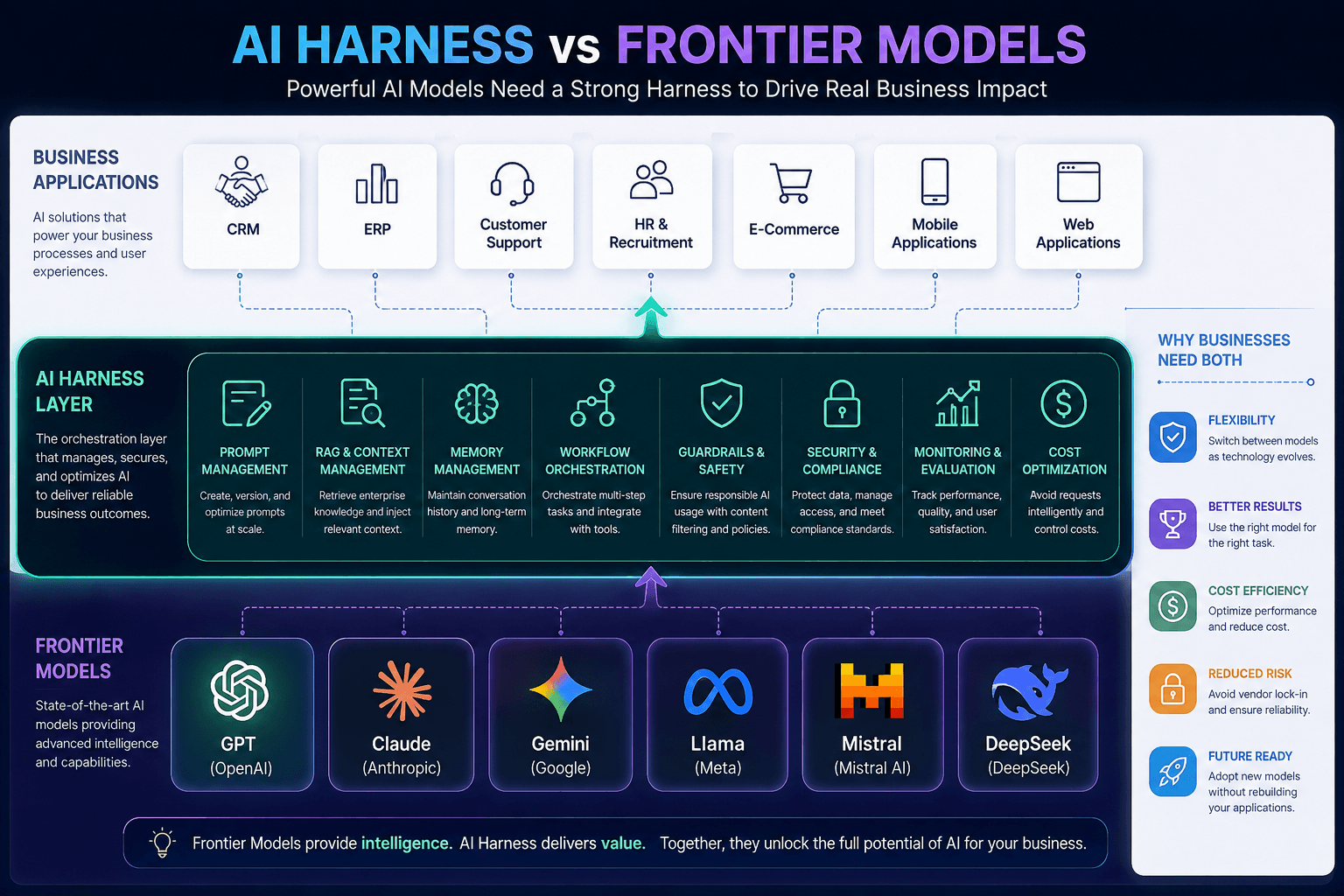
AI Harness vs Frontier Models: Why Enterprises Need More Than Just Powerful AI
Artificial Intelligence is evolving at an incredible pace. Every few months, a new "most powerful" AI model is announced, capable of writing code, generating content, solving complex problems, or even acting as an autonomous agent. While these frontier models receive most of the attention, successful AI implementations inside businesses rely on something equally important—an AI Harness. Understanding the distinction can help organizations avoid expensive AI mistakes and build scalable, secure, and future-ready AI solutions.
Read more
Choosing a Vector Database for AI Search
pgvector, Pinecone, Qdrant, Weaviate — how to pick a vector store based on scale, filtering needs, and operational appetite.
Read more
Building Reliable AI Workflows with LangChain
LangChain helps compose LLM steps, tools, and memory. Where it helps, where it gets in the way, and how to keep chains debuggable.
Read moreTrending posts
AI Harness vs Frontier Models: Why Enterprises Need More Than Just Powerful AI
Artificial Intelligence is evolving at an incredible pace. Every few months, a new "most powerful" AI model is announced, capable of writing code, generating content, solving complex problems, or even acting as an autonomous agent. While these frontier models receive most of the attention, successful AI implementations inside businesses rely on something equally important—an AI Harness. Understanding the distinction can help organizations avoid expensive AI mistakes and build scalable, secure, and future-ready AI solutions.
Read more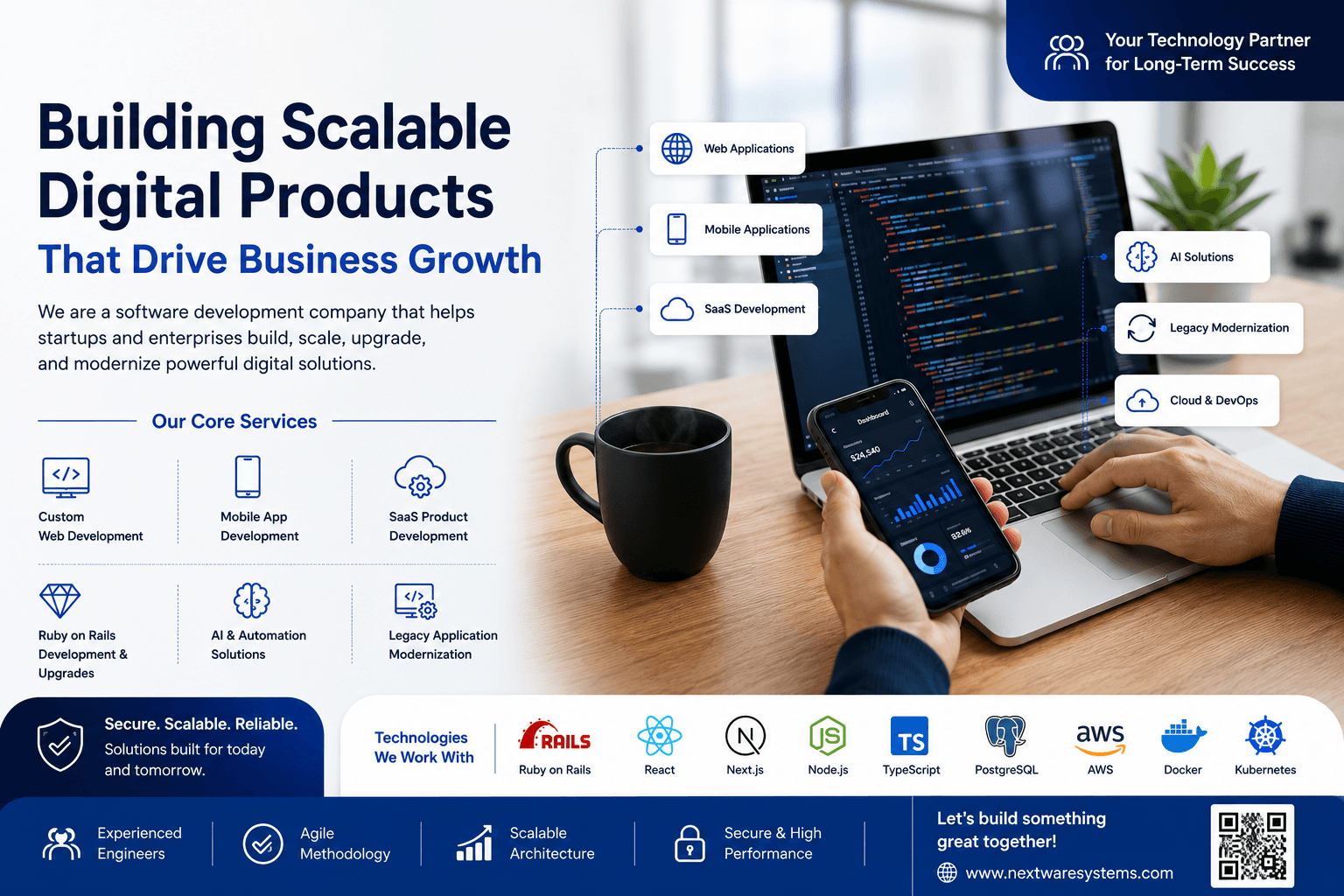
Building Digital Products That Scale: Why Businesses Choose Nextware Systems as Their Technology Partner
Building Digital Products That Scale: Why Businesses Choose Nextware Systems as Their Technology Partner
Read more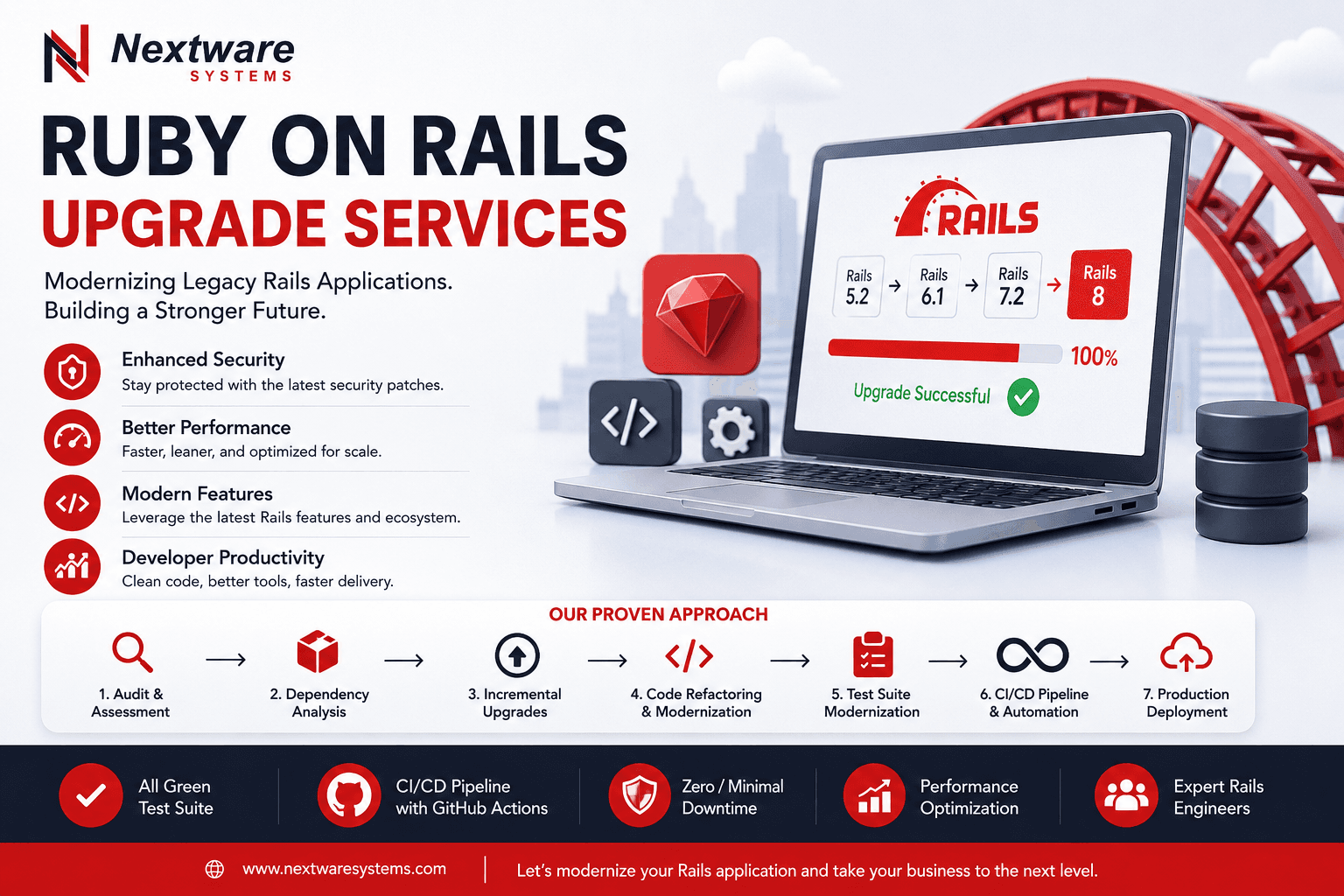
Ruby on Rails Upgrade Services: How Nextware Systems Modernizes Legacy Rails Applications Without Breaking Production
Is Your Ruby on Rails Application Falling Behind?
Read morePopular posts

Background Jobs in Rails 8 with Solid Queue
Solid Queue brings durable, database-backed jobs to Rails by default. Setup, recurring tasks, and when you still want Sidekiq.
Read more
Server Components in Next.js 15: A Practical Mental Model
RSC changes where code runs. A working mental model for fetching, the client boundary, and shipping less JavaScript.
Read more
Deploying with Docker and Kamal on a Plain VPS
Containerize once and deploy anywhere you can SSH. Kamal brings zero-downtime deploys and TLS to a cheap server.
Read more
Rails 8 Is Here: The No-PaaS Default Stack Explained
Rails 8 ships with Kamal 2, Solid Queue, Solid Cache and Propshaft, making a database-only, deploy-anywhere stack the default. Here is what changes.
Read more
0 Comments
Sign in to join the conversation.
Sign-in is not configured yet.